


NAD testing in blood provides a direct insight into a metabolic health, making it especially valuable for individuals supplementing with NAD boosters (see Figure 1). Our dried blood spot (DBS) testing method offers unparalleled convenience for both laboratories and end-users. For end-users the test allows for easy at-home sample collection by placing a few drops of blood on a specially designed paper card. For laboratories our method is simple to implement, and we provide comprehensive support to ensure seamless integration. DBS samples based on our testing method can be shipped worldwide, making NAD testing accessible to a broad customer base. Traditionally, NAD testing from DBS could only measure total NAD (often labeled as intracellular NAD⁺ by many providers). However, through extensive R&D, SensoLife has developed the first comprehensive NAD test on the market, capable of measuring both NAD⁺ and NADH.
- NAD⁺ (oxidized form) is essential for energy production, DNA repair, and cellular metabolism.
- NADH (reduced form) plays a crucial role in energy transfer within cells.
- By measuring both forms, our test provides insights into:
- Total NAD – the sum of NAD⁺ and NADH, indicating your overall NAD pool and metabolic state.
- NAD⁺/NADH Ratio – reflecting your body’s redox balance, crucial for a healthy metabolism and mitochondrial function.
These measurements, taken from a dried blood sample, offer a metabolic health snapshot.
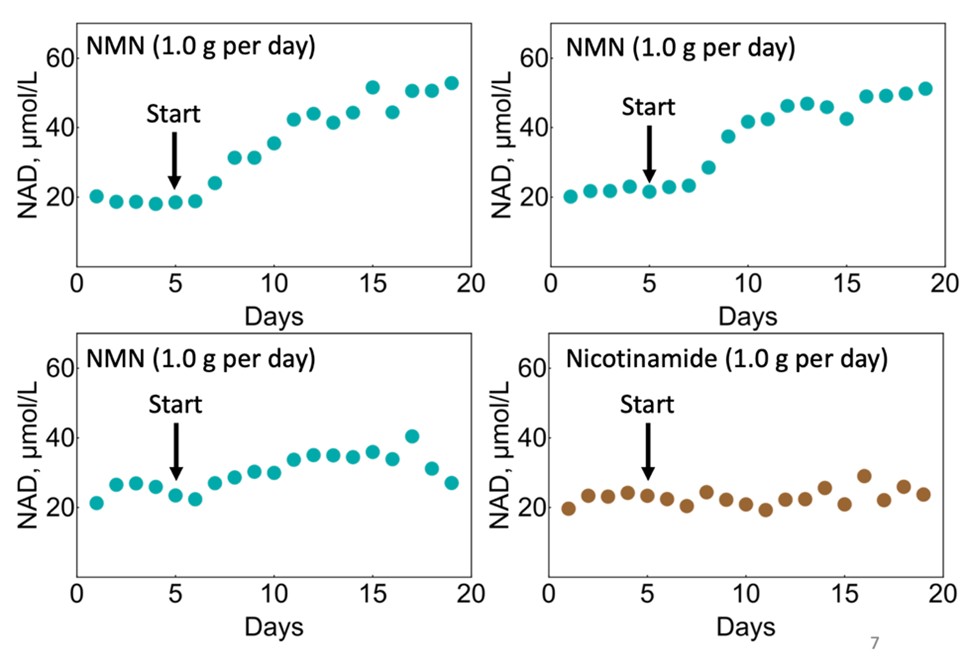
Figure 1. Data how booster NAD supplement (NMN) changes NAD levels in blood over the course of 20 days before and after supplementation. A comparison is given versus nicotinamide.
Technology
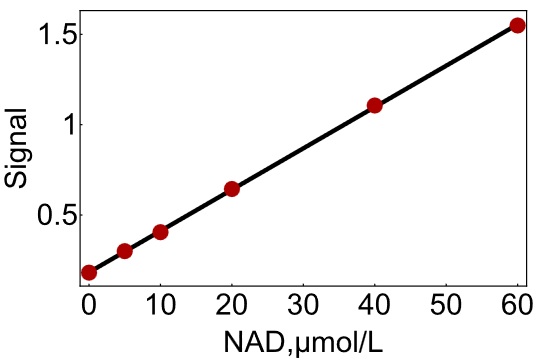
Figure 2. Typical calibration curve of NAD testing method showing a perfect correlation (R2=0.999) between NAD concentrations and signal.
Developing a complete NAD test is highly complex due to the instability of NAD⁺/NADH outside the blood, its low concentration, and its primary presence in erythrocytes. Our advanced technology overcomes these challenges through a multi-step process:
- Specialized DBS paper cards. Unlike the competitors who provide fixing buffers, we pretreat our cards with stabilizing compounds, ensuring NAD is preserved immediately upon sampling. No need to consumer to fix anything.
- Efficient sample processing. Upon arrival at the lab, a standardized portion of the DBS card is punched out, and the sample undergoes extraction to stabilize NAD⁺ and NADH.
- Selective separation. The extracted solution is divided: one portion undergoes special treatment to remove NADH, leaving only NAD⁺.
- Enzymatic reactions for detection. Highly selective enzymes interact with NAD, triggering a reaction that produces a color proportional to the NAD concentration (see Figure 2).
This proprietary approach ensures high sensitivity, stability, and reliability in NAD measurement.
Key parameters
| Parameter | Specification |
| Method name | Enzymatic cycling assay for NAD detection |
| Suitability | For human dried blood spot analysis, could be adjusted for other sample types |
| Relative standard deviation (RSD) | 6.6 % |
| Limit of detection (LOD) | 0.23 µmol/L total NAD (NAD+ and NADH) |
| Limit of quantification (LOQ) | 0.40 µmol/L total NAD (NAD+ and NADH) |
| Linear range | 5–60 µmol/L total NAD (NAD+ and NADH) |